



 UK
 NL
 IT
 FR
 ES
 DE
 AU
 HR
 AR
Gluten or Fructans? How Grains Affect Your Digestion
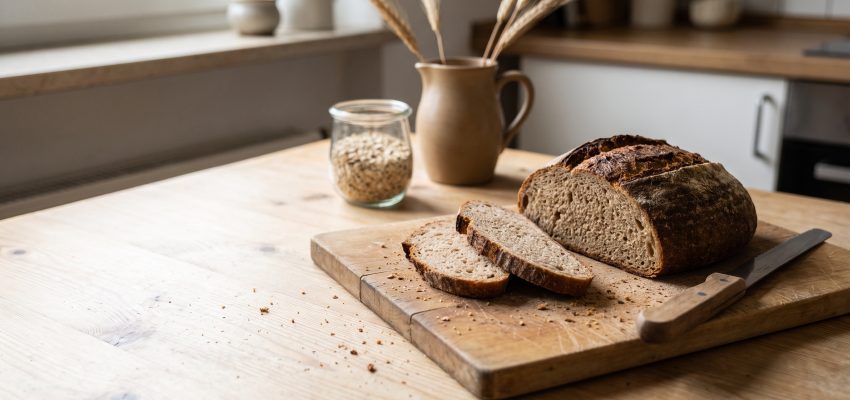
A sandwich for lunch, pasta for dinner, and a few crackers somewhere in between. If your stomach isn’t always happy with that, going gluten-free can seem like the obvious next step. But gluten isn’t always the culprit. Wheat, rye and barley also contain fructans: carbohydrates that belong to the FODMAPs. Gluten and fructans often show up in the same bread, but they are two very different things. Once you know the difference, you can make more targeted choices and avoid cutting out more than you need to.
In Short
- Gluten is a group of proteins in wheat, rye and barley; fructans are carbohydrates found in the same grains, as well as in onion, garlic and inulin.
- Gluten-free doesn’t automatically mean low in fructans, and low in fructans doesn’t automatically mean gluten-free.
- In a Norwegian study, fructans caused more symptoms than gluten in people with self-reported gluten sensitivity.
- Celiac disease should always be diagnosed by your doctor, while you are still eating gluten.
- Digestive enzymes don’t break down gluten; they are meant for hard-to-digest carbohydrates.
What Is Gluten?
Gluten is a group of proteins found naturally in wheat, rye and barley, and in spelt, an ancient type of wheat. Gluten gives dough its stretch: it helps bread rise and pasta hold its shape. In celiac disease, the immune system reacts to gluten and the small intestine becomes damaged. People with celiac disease need a strict gluten-free diet for life.
What Are Fructans?
Fructans are carbohydrates: long chains of fructose units that plants use to store energy. The human body has no enzyme to break down fructans in the small intestine. As a result, most fructans reach the large intestine undigested, where gut bacteria ferment them. This process produces gas. Fructans are one of the FODMAPs, the group of carbohydrates that is temporarily reduced on a low FODMAP diet.
Fructans are found in wheat, rye and barley, but also in onion, garlic, the white part of leeks, artichokes, and added inulin or chicory root fiber.
What Is the Difference Between Gluten and Fructans?
The key difference: gluten is a protein, fructans are carbohydrates. They occur in the same grains, but they do different things in your body. Celiac disease is an immune reaction to gluten. Fructans are carbohydrates that ferment in the large intestine, which can cause gas and bloating in sensitive people.
That also explains why some people feel better after cutting out bread and pasta, even though gluten isn’t the cause. When the bread goes, the fructans go with it.
Is Gluten-Free the Same as Low FODMAP?
No. Gluten-free and low FODMAP overlap, but they are not the same. A gluten-free product can be high in fructans, for example when inulin, chicory root fiber or soy flour has been added. On the other hand, a product that contains gluten can still be low FODMAP.
The best-known example is traditionally made spelt sourdough bread. During the long rise, yeast and bacteria break down a large share of the fructans, as Monash University explains. The bread still contains gluten, but it is low FODMAP in a normal serving. Rice, quinoa, buckwheat and millet also fit a low FODMAP pattern in a normal serving, and oats and corn in a moderate serving. So always check the label on gluten-free products.
What Does Research Say About Fructans and Gluten Sensitivity?
A widely cited study comes from Norway. Researchers had 59 people with self-reported gluten sensitivity, in whom celiac disease had been ruled out, eat muesli bars for a week at a time, in random order: bars with gluten, with fructans, or with neither. No one knew which bar they were getting. On average, the fructan bars caused more symptoms, such as bloating, than the gluten bars (Skodje et al., 2018).
In this study, gluten caused no more symptoms than the placebo bar. That doesn’t mean gluten never plays a role: the group was small, the test period was short, and the symptoms were self-reported. But it does show that it’s worth looking beyond gluten alone. Monash University also points out that in people with IBS symptoms, fructans may be more likely to be the cause than gluten.
Should You Get Tested for Celiac Disease First?
Yes. If you have symptoms after eating bread or pasta, have celiac disease ruled out before you go gluten-free on your own. The American College of Gastroenterology guideline advises testing while you are still eating gluten, because test results can return to normal on a gluten-free diet and the diagnosis can be missed (ACG guideline, 2023).
Once celiac disease has been ruled out, a registered dietitian can help you find out whether fructans or other FODMAPs play a role.
How Do You Cook and Bake With Fewer Fructans?
Eating fewer fructans doesn’t have to be boring. A few simple swaps go a long way:
- Choose spelt sourdough bread or a gluten-free bread without inulin or chicory root fiber.
- When baking, replace wheat flour with rice flour, buckwheat flour or a gluten-free flour blend, and check the label.
- Use garlic-infused oil instead of garlic. Fructans don’t dissolve in oil, but the flavor does.
- Use the green part of scallions or leeks, or chives, instead of onion.
- Watch your portion size: FODMAPs from different ingredients add up.
Beans and lentils contain galactans, another type of FODMAP that often shows up alongside fructans in the same meal.
What Do Digestive Enzymes Do With Fructans and Galactans?
Digestive enzymes break down nutrients that your body has trouble digesting on its own. They do not break down gluten, so they are not meant for celiac disease. They can be a practical help with meals that contain hard-to-digest carbohydrates, for example when eating out and you don’t know exactly what’s in your food.
Fibractase 1200 contains the digestive enzyme alpha-galactosidase. You take 1 to 3 capsules right before or with your first bite; the enzyme stays active for 30 to 45 minutes.
Fodmix is a blend of four digestive enzymes: alpha-galactosidase, xylose isomerase, lactase and invertase. Both products are vegan and certified low FODMAP by Monash University.
Samples of this product have been analyzed and classified as low FODMAP. A strict low FODMAP diet should not be started without the supervision of a doctor or dietitian.
Gluten or Fructans: Where Do You Start?
Start with the basics: have celiac disease ruled out, then work with a registered dietitian to find out which carbohydrates play a role for you. That way you avoid cutting out more than necessary, and you keep room for the foods you enjoy.
Do your symptoms persist, are you losing weight without trying, or are you cutting out more and more foods? Talk to your doctor or a registered dietitian.
Not sure where to start? Our dietitians are happy to help you figure out what works for you.
Sources
- Skodje GI, Sarna VK, Minelle IH, et al. Fructan, rather than gluten, induces symptoms in patients with self-reported non-celiac gluten sensitivity. Gastroenterology. 2018;154(3):529-539.e2.
- Rubio-Tapia A, Hill ID, Semrad C, et al. American College of Gastroenterology guidelines update: diagnosis and management of celiac disease. American Journal of Gastroenterology. 2023;118(1):59-76.
- Monash University. Gluten and IBS. Monash FODMAP blog, 2021.
- Monash University. Sourdough processing & FODMAPs. Monash FODMAP blog, 2017.

